There is nothing left to Like

We all know the word ‘like’ has changed its meaning. Ever since Facebook allowed us to ‘Like’ an update, photo or link from a friend, ‘like’ has come to mean ‘agree’, ‘acknowledge’ or ‘appreciate’.

Tee Shirt: Your MomWhere Facebook users used to reply to a friend’s update with a remark or opinion of their own, a simple click of the Like button now does the job of conversation in a split second, allowing us to move on to the next stimulus.

And then Facebook set its Like button free, so the ubiquitous blue thumb has been allowed to flourish on blogs and sites all over the place. Any content on any site, a song, a photo, a video or a blog post can be Liked, as Facebook continues its attempt to position itself as the common ground between all our online identities.

Now it looks as if Liking has gone a step further.

I noticed this morning, while paddling around in Facebook, a clutch of updates from friends that follow a new format. An update shows that a friend has ‘liked’ a sentence, linked, and followed by a symbol such as or  .

These words aren’t the words of my friends. They are others’ words they have ‘Liked’. Clicking on the linked text goes to a site hosting a list of statements – many of them trite, crass and arguably of minimal real value. In five short minutes, I have followed links to three sites – YouLike, LikeEverything and LikeMyThought – all virtually identical. They are just lists of sentences, scored, ranked and, of, course, with each given its own Like button. Anyone can add a line of text, without even logging in, and these words can then be Liked by anyone with a Facebook profile.

With this new development, Liking has become an end in itself – not just a way of responding to others’ content, but as a way of achieving, or borrowing, credibility. Liking is no longer an opinion you have of content. Liking is content. Oh dear.

Facebook’s Like button allows us to be lazy when responding to other people’s opinions. Now this new trend allows to extend this laziness to the creation of our own opinions. Not content to automate our responses to our friends’ opinions, we’ve now been granted the freedom to refrain from even having an opinions of our own. Why bother, when you can simply borrow someone else’s?

I’m giving up Liking for a while. Seriously. I’m as guilty as anyone of this new shorthand. Let’s see if I can genuinely like things without Liking them. You never know – I might just like it.

(T-shirt image courtesy of Already Have a Flickr Account?)
Posted in internet | Leave a comment

One of those ‘This is what the internet was made for’ moments.

Here’s something that made me smile:

  1. Frank Turner, currently one of my favourite musicians, mentions on Twitter that he’s about to play a free gig in Winterthur, Switzerland later in the day.
  2. My friends Rebecca and Simon live in Winterthur, so I suggest, through Twitter, that they may want to go along.
  3. Rebecca and Simon haven’t heard of Frank Turner, so they sample his tunes via the web.
  4. It’s a pleasant evening in Switzerland so Rebecca and Simon decide to go along.
  5. Rebecca and Simon send me, via Yfrog and then Flickr, photos from the gig.

Frank Turner, Musikfestwochen, Winterthur

5. Frank Turner gets a new fan, Becs and Simon get a good night out and I, half a continent away, get to see what a good time they had.

That (among a few other things) is what the internet was made for.

Posted in internet, music | Leave a comment

Thank Martin for Picr: making it easier to share images from a Flickr set

I’m a big fan of Flickr. It has so many features, such functionality and such a network of communities that, in addition to using it for my own personal photos, I use Flickr for work-related projects.

If I have a Flickr set of photos relating to a specific event, I can show them to colleagues, contacts or journalists. And if a colleague needs a full-sized version of any image, Flickr gives me, via a couple of right-clicks, a URL for the original size of any of my images (This is only available to Flickr Pro account holders). I’m not just referring to the URL for a Flickr page – I mean the link to the image itself, and I can share this image URL with anyone, preventing the need to send large files via email.

So what’s the problem?

The ability to distribute images via the web is a great facility. But I frequently find myself promising a set of originals to a colleague, and then tediously right-clicking, copying and pasting my way through a large set of images, compiling a list of URLs within an email.

One day recently, as I was working through a set of images, retrieving original image URLs, I wondered aloud, via Twitter, if anyone knew a clever way around the problem.

The answer I got was not what I expected:

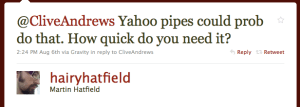
A guy called Martin Hatfield, through his Twitter account of @hairyhatfield, noticed my Tweet and offered to help. I’ve never met Martin, but he seemed to understand my plea and, as a guy who appears to know how tinker with the web, he set to work with the Flickr API, Yahoo Pipes and whatever other clever tools he uses.

A few days later, Martin contacted me again and unveiled his creation: Picr. A tool to automate the process of compiling image URL lists from Flickr sets.

How Picr works

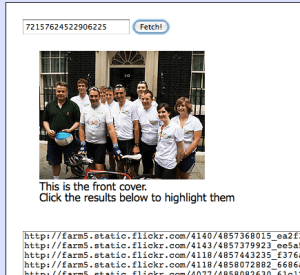
The way Picr works is simple – you just enter the number relating a Flickr set (the unique number that forms part of the set’s ID), and you are given a list of the URLs relating to each image in the set. These are not the page URLs – they are the URLs of the actual image files. This list can then be copied, pasted and emailed to anyone I’d like to have quick easy access to the image files.

Images sizes and privacy settings

Picr gives you the image file for the largest file that’s publicly available, so if your Flickr permissions are set for everybody to have access to your original files, that’s what Picr will provide. If your Flickr account has been set to limit access to the original sized files, then Picr will provide a list of the URLs for the medium-sized images, as seen on regular Flickr pages.

Help with these permissions can be found on the Flickr FAQ.

If you’re currently logged in to Flickr, here is the page you need to govern access to your original versions.

It’s important to remember that Picr doesn’t bypass any of the privacy settings you have set for your Flickr account. If you’d like to be given a list of original-sized image URLs, your permissions settings must allow public access. If you’re happy to receive URLs for medium-sized images, then your account can have tighter privacy settings. Picr simply retrieves the URL for the largest publicly-available version of each image. If you can’t decide between the utility of accessing a full list of a set’s original URLs and the security of tighter Flickr settings, a simple solution is to alter your Flickr settings only long enough for the time it takes Picr to do its job – a few seconds – before resecuring your Flickr account. This may seem a hassle, but compared to the time Picr may save you, it’s no big deal.

Why this is good

Of course, Picr is a fairly specific tool for a fairly specific job. It will certainly save me time, but I appreciate not everyone uses Flickr in the way I do.

Perhaps more importantly, the appearance of Picr has reminded me a couple of things:

  • There is so much that can be done with the mass of APIs, RSS feeds, Yahoo Pipes and clever developer tools. And when combined with the knowledge of how to use them (provided in this case by Martin), the potential solutions are countless.
  • Secondly, I have been reminded of the willingness of near-strangers to help each other; to share skills, to solve problems. I have never met Martin in the flesh and I only vaguely know him through Twitter. But that didn’t stop him hearing my call for help and coming to my rescue with Picr. If I do ever meet Martin, the beers are most certainly on me.
Posted in computing, internet, photography | 1 Comment

Do some cycle road markings do more harm than good?

All over the UK, local authorities spend money and effort improving conditions for cyclists in a bid to encourage the use of bikes. Wherever we see painted cycle markings on the road surface, we get the feeling that something positive is being done to improve the situation for cyclists. But is this always the case?

Putney cycling 2 Putney cycling 1

What are these? Cycle markings, in the commonly recognised format. This looks great.

But what do they tell me? As a cyclist or driver, what information do these signs convey? I’m not actually certain…

Are they on a recognised or recommended cycle route? Not according to the London cycle route maps produced by London Cycling Campaign and Transport for London, no.

Do they indicate a cycle lane? No. The street in question is a busy suburban street. There would be no space for an actual cycle lane. They are simply cycle markings in the main carriageway of the road.

Do they indicate the correct position on the road? I really hope not. Correct position cannot be mandated – it needs to be decided dynamically by the rider. If taken as an indication of proper road positioning, these markings are dangerous. A rider following the position shown in the first picture would place themselves in prime position for a ‘dooring’, one of the most frequent, and painful, of cycling accidents.

Parked cars should, wherever practical, be passed by a margin that allows a door to be unexpectedly opened by a unobservant driver. If a cyclist knows better than to follow the positioning of these markings, other road users may then question their use of the road. Neither drivers nor cyclists need any more potential for negative feeling or misunderstanding.

Markings to indicate recommended road positions are sometimes called sharrows, especially when used in North American cities. But they are usually seen on wider roads.

Do these markings simply remind drivers that bikes may be present on this road? If so, this is well-meaning, but worrying. If we start marking roads as being used by bikes, where does that leave us on unmarked roads? Cyclists should be expected on all roads.

I’m intrigued to know how these markings are intended to help, and I’m contacting Wandsworth Borough Council to ask why.


View Larger Map

Posted in cycling | 1 Comment

Travel photography tips from a Greek adventure

I’m a casual photographer with no formal expertise. I learn through mistakes and lucky shots.

Hydra quaysideA two week trip to to Greece in 2009 was an action-packed holiday with lots of opportunities for photography. A week of watersports and mountain biking with Poseidon Sports was followed by a week of island-hopping towards Athens. I came home with several thousand images on my memory cards. Some shots were good. Many were not. I learned some useful photographic lessons from the adventure, and here I’d like to share them.

If you want professional opinion on photographic technique, you’re probably best speaking to experts like lomokev or Garage Studios about some training.

But here are some simple little travel photography tips I’ve picked up through trial-and-error while travelling in Greece. If you’re a photographer, feel free to correct, criticise or add to anything I say here. I’m still learning. And I’m loving it.

Cameras and lenses

I only have a modest pair of basic cameras, so the task of selection for my trip to Greece was not difficult. My Canon EOS 400D DSLR came with me, accompanied by its three lenses – a Canon 18-55mm, a Canon 50 mm f/1.8 (great for portraits and low light) and a Sigma 70-300mm (with macro). I used all three lenses and I’m glad I took them, despite their bulk. If you are blessed with a greater number of lenses, consider which ones you really use and which ones you’re willing to carry. It may be a hard decision.

My Canon PowerShot S70 compact is getting old but has helped me to take some of my favourite photos, particularly while mountain biking. Its toughness and portability means I often carry it in situations where I may not have my SLR to hand.

'Yakking MelAs an accessory, I have a waterproof case for the Canon PowerShot. This housing enables photos in or near water. On a watersports holiday, that brings huge opportunities.

Additionally, a mobile phone with a decent camera is no substitute for a real camera, but often helps to capture fleeting moments, and can be handy for instant uploads of travel photos to blogs and social networks.

Batteries

While travelling, access to electricity may be unpredictable, so a good handful of spare batteries is a worthwhile investment for your camera bag. Bear in mind that unbranded ‘pattern’ batteries are often priced far more keenly than original batteries from camera manufacturers.

Carry a charger for the times you are able to plug it in, but be aware of the voltage in the country you’re visiting. UK and mainland European voltages are inter-compatible, and some, but not all, UK-bought chargers and appliances can operate on the 110 volt supplies used in Canada and the USA. Check the label. If your charger plugs in via a detachable ‘figure of eight’ lead, try to obtain an equivalent mains lead with the plug of your host country – saving the weight of an additional UK plug adapter.

Polarising filters

Moni inlet 2If  using an SLR anywhere in the sunshine, polarising filters are virtually essential. Harsh sunshine can overwhelm the camera as well as the eye. A polarising filter acts like a pair of sunglasses, moderating the harshness of strong sunlight. Polarising filters are particularly worthwhile when photographing water scenes, cutting reflections and capturing clear blue seas. Polarising filters are available in sizes to fit the diameter of lenses, measured in millimetres, so get the right ones for your equipment. Screw onto the end of your lens and rotate the filter until you see an improved image through the viewfinder.

It’s tempting to leave polarising filters on your lenses semi-permanently when in sunny places, but don’t forget if you have one fitted. Action photos or shady scenes can be made harder to expose correctly by the presence of a polarising filter, so judge the need of each photo individually.

Data storage

After taking great pictures, you need to keep your data safe until you get home. With large files, enthusiastic clicking and some precautionary bracketing, it’s likely you’ll end up with several gigabytes of files. The first step is to invest in some good-sized memory cards. Keep them in their little plastic cases and protect them in a dedicated bag, pouch or pocket. Then consider back-up. Will you be carrying a laptop? Will you have access to a computer during your trip? If so, you can back up your files to DVD, to a hard drive or an online service like Dropbox or MobileMe. Halfway through my trip to Greece, while visiting a friend, I backed up all my photos onto her computer and onto a portable hard drive I kept in my camera bag. If using public computers in places like internet cafés, be especially wary of viruses that may be carried on memory sticks or flash memory cards. A sound anti-virus package on your home computer should reduce the chances of bringing home an unwanted infection.

Bags

I took a Lowepro Flipside 300 and a CCS Warthog pouch. I stored all my kit safely and conveniently in my Flipside, while using the tough waterproof Warthog for day trips and mountain biking. So while travelling between locations, I had two bags to carry – one bag of camera kit and another containing the Warthog and my other possessions. During the second half of the holiday, I was constantly mobile and the extra luggage became tiresome. I wish now I’d just taken the Warthog, and carried spare lenses and accessories in pouches stored in my main baggage.

Take equipment you will use, not clutter you won’t

The bulkiest bit of equipment I took to Greece was a tripod, yet I rarely used it. My current tripod is of low quality. I don’t enjoy using it and it gives variable results. In retrospect, I should have either bought a good quality tripod before my trip, or simply left this awkward kit behind.

On the other hand, the waterproof housing for the Canon PowerShot is admittedly bulky and heavy. Am I glad I took it? Yes. Watersports and swimming were significant aspects of my trip to Greece, so my housing enabled me to get pictures that capture some of the best moments of the adventure.

Judge each item of equipment realistically, assessing how likely you are to use it and whether you really want to carry it.

Bracketing

Correct exposure can be tricky at the best of times. With the added factors of bright sunlight, strong shadows, whitewashed buildings and possibly the use of a filter, it can be very difficult to pick the right settings. So have a go at ‘bracketing’ your shots. If you think you’ve got a good picture, take some more that are underexposed and some that are overexposed. Take lots. When you get home you’ll have variously exposed versions, one of which will be the basis for your finished picture.  Find the exposure compensation control on your camera, sometimes marked Av +/-, and play with it.

Horizons

When spending time on the coast, the sea becomes an inevitable background to many photos. And where there are seascapes, there are usually horizons. The goal of a level horizon, straight from the camera, is virtually impossible to achieve. Leave adjustment ’til you get home, but give yourself something to work with: If your photo includes a horizon, don’t zoom right in on your subject unless you have to. Straightening and cropping a photo will sacrifice areas around the edge of your photo, so bear this in mind when composing a shot with a visible horizon. Don’t zoom in too much.

Flags

Maybe it’s a cliché, but many people choose to take photos of flags while visiting foreign countries. If you do this, take a few shots. Fluttering flags give unpredictable results. What looks like a proudly flying Greek flag may, when photographed, come across as an awkwardly folded sheet of stripy cloth. So grab several photos, allowing you to later select the one that best shows the flag.

Military Areas

Greece has a reputation for sensitivity regarding photography around military areas. An incident at Kalamata airport in 2001 shows how serious this can be, so be wary of photography near any military equipment or personnel. Bear in mind that many smaller Greek charter airports, such as Kalamata and Preveza, double as military airfields, even if this is not immediately obvious.

Whether in Greece or anywhere else, be careful.

Tagging and keywords

Once you’re home, you will possibly process and archive your photos. You may choose to share them on a social site like Flickr. In most cases, you’ll tag your photos so they can be easily found, by you, by website visitors, by search engines or by stock agencies. Tags might include words like Sailing, Sea, Catamaran, Greece and Sunglasses as well as words that describe the location in which the photo was taken.

In some countries, including Greece, this presents an interesting language situation. Many places in Greece have multiple spellings using the Greek alphabet. When transliterated into Roman text, as read by English speakers, the various possible spellings multiply still further. If you’re tagging your photos comprehensively, it makes sense to use all the variations you know of.

For example, I spent half of my Greek adventure in the town of Porto Heli (Πορτο Χελι in Greek). This can be spelled in several different ways, so my Flickr photos have been tagged with:

Porto Heli, Porto Cheli, Portoheli, Portocheli, Πορτοχελι, Πορτο Χελι

This may seem like an unimportant detail, but it maximises the chance of my photos being found by other people. If you’re visiting a location with several names, or with various spellings, use them all for your tags and keywords.

The photos of my 2009 trip to Greece can be seen on Flickr.


Posted in photography, travel | Leave a comment

A brand new bag

Two courier bags. One black, one red.

I’ve owned one of them for around 7 hours. I’ve owned the other for for about 12 years.

One is brand new. The other is rapidly falling apart.

One of them has just been bought from the howies shop in Carnaby Street. The other came from a bike shop in Liverpool.

One of them sports crisp new buckles that click loudly. The other has long since lost the working parts of all its buckles and has twice been repaired by a shoemender in Brighton.

One smells of new shoes and outdoor shops. The other smells of biscuit crumbs and sweaty cycling kit.

One has a fleecy pocket for an MP3 player. The other was made before the iPod had been invented.

One has a handy sleeve for my laptop. The other was made at a time when I would carry a small box of floppy disks.

When I pick up one of these bags it feels unfamiliar and a little awkward – like it belongs to someone else. The other one moulds itself perfectly to the shape of my hip and lower back, like it’s part of my body. It has been with me virtually every day for over a decade, going to work, going travelling, going on bike rides and sharing adventures.

Let’s see what the next 12 years has in store.

Posted in design, travel | 3 Comments

Nick Meadows and his Eco-Trike

Last night, as I set off for an off-road ride through Alice Holt Forest, I was distracted by an unusual-looking wheeled contraption in the corner of a Forestry Commission car park. Intrigued, I rolled over to investigate.

What I saw fascinated me. I found a vehicle the size of a small car, with three bicycle wheels. It had a sturdy roof and a cockpit enclosing a recumbent seat within flexible transparent walls. The forward-facing pedals were connected via several chains and mechanisms to a rear wheel that seemed to feature suspension and electrical assistance. Attached to the rear of the bodywork was a further baffling assembly of wheels and cranks.

As I examined this impressive machine, a figure emerged from a folded-down seating area at the front of the vehicle. The man introduced himself as Nick Meadows, and proceeded to proudly show me around his creation – the Eco-Trike.

Nick eagerly showed me the TIG-welded chassis, the electrically assisted drive mechanism and the solar panels covering the roof. He explained how a bed could be folded down from the ceiling and how the Eco-Trike could hold enough water, food and power to enable several days of self-sufficiency.

I was ushered towards the back of the vehicle, where I received an explanation of the assembly strapped to the roof. Three windmill-style sails could be attached to a bike wheel, which then drives a marine alternator as a supplement to the power provided by the solar panels and human exertion. A quick blast from the Eco-Trike’s sound system demonstrated capabilities of the impressive electrical system.

It seems Nick likes an adventure. He told me of his love of travel and how, after spending a year building the Eco-Trike, he intends to ride to Dover and onward through Europe. His ultimate goal? Gambia in Africa.

I’m no stranger to peculiar bike-powered assemblies (I’ve seen bicycle sound systems and pedal-powered garden machinery) but I’ve rarely seen anything as elaborate, as intensively engineered and as passionately built as Nick’s Eco-Trike. I wish him all the best with his travels.

Nick’s website is called The Other Way, where he has more information about the Eco-Trike and his travel plans.

Posted in cycling | 1 Comment

Compulsory insurance for cyclists: Why not?

In the UK, if you ride a bike, write about bikes or work with bikes, there are certain thorny debates that crop up repeatedly: helmets, insurance, licensing, red-light-jumping and road tax are the usual favourites for discussion with journalists, motorists or fellow riders.

This morning was the turn of insurance. Oddly prompted by government proposals around compulsory insurance for dog owners, an exchange of views broke out on Twitter, debating the pros and cons of mandating third party insurance for cyclists. Such a move would ensure that in the event of a cyclist being at fault in an accident, compensation could be made available to injured parties. There seemed to be some firmly held, and sometimes opposing, views on the subject among @carltonreid, @velofello, @markbikeslondon, @FatManonaBike, @John_the_Monkey, @cyclepod1, @breadedcod and me, @CliveAndrews.

On the face of things, this looks like a reasonable idea. An equitable idea. Motorists are required to have third party insurance, so by taking responsibility in the same way, cyclists can be seen as equal to their four-wheeled contemporaries.

Will & Kate. London Junction.But there is a huge flaw in the idea of compulsory insurance for cyclists:

Of those who believe cycling to be a good thing for our society and our environment, most would like to see greater numbers taking to two wheels. With this in mind, we owe it to ourselves to ensure cycling remains as approachable, as accessible and as ‘normal’ as possible.

Committed cyclists may think nothing of investing a few quid in third party insurance. Many of us, through membership of cycling organisations, already hold insurance, so a compulsion to obtain third party cover will be no obstacle to our riding.

But what of those millions of people on the brink of deciding whether or not they should drive a little less and cycle a little more, and who would never define themselves as ‘cyclists’?

In a system with compulsory insurance for cyclists, the only people riding bikes would be those who take the deliberate decision to label themselves as cyclists by making the effort to obtain insurance. Do we want a small number of committed, legally paid-up cyclists feeling smugly secure in their legal parity with motorists, or do we want cycling to be accepted as the easy, affordable hassle-free way for everyone to get around?

We are all road users, making our own decisions about which vehicle to take to school, work or to the shops. If we want more people to use two wheels for short journeys we should not do anything to take cycling further out of the hands of the average citizen and into the hands of people who have chosen to commit to cycling as an officially documented lifestyle choice.

Some arguments on the politics of road use fall into the trap of adopting an ‘us and them’ mentality. We are the cyclists. They are the drivers. This ill-advised idea has a similar effect: We are the cyclists. They are are the non-cyclists. And if they want to join our club they will need an official piece of paper to show they are serious.

A very bad idea.

(Disclosure: I work for CTC, the national cyclists’ organisation, but this blog post is unconnected with my work role)

Posted in cycling | 13 Comments

Why wait all summer for the mountains? Plan a biking trip now for next year

I was asked by Carolyn of Chalets Direct to contribute a post about biking in the Alps for The Ski Blog.

I first met Carolyn in 2001, when we were both living and working in Chamonix, so she knows how much I love mountain biking. I was happy to write a few words.

Here’s the blog post I wrote, originally posted on the Chalets Direct Ski Blog:

It’s that time of year when the days shorten, the temperature drops and you realise it’s only two or three months until your annual trip to the mountains, right?

But where have you been for the last six months? The mountains you long for each winter are there the whole year round and, if you’ve never visited in the summer, you have been seriously missing out. Don’t spend your time from May to October dreaming of the Alps, Dolomites or Rockies when you can experience them amid the beauty of green meadows and sparkling lakes instead of snow and ice.

If you love the excitement of skiing or snowboarding, the best way to enjoy the slopes during the warm snowless months is clear: mountain biking. Skiing, boarding and biking share a similar buzz, and all three let you pick a route down the mountain to suit your appetite for excitement. Challenging gradients or easy cruising – it’s up to you.

And like just like the après-ski of a winter holiday, there’s no better way to reflect on a day’s biking adventures than over a meal and a couple of beers with friends.

If you have concerns about your level of off-road cycling skill or about the necessary equipment for Alpine cycling you needn’t worry. Many ski shops become well-equipped bike hire shops in the summer and ski instructors can often be found offering their services as bike guides once the snow has melted.

But why talk about this now? This may seem entirely the wrong time of year to be oiling the chain and pumping up the tyres as the snow starts to fall. Well, yes, but now is the time to start planning a week in the mountains for next summer. That way, when you fly home from this winter’s alpine excursion, you can smugly remember that it will be only a few short months before you head out for some clear mountain air once more.

So where to go? The choice of summer alpine destinations is no less overwhelming than the question of where to ski or snowboard.

Here are just three I have ridden and loved:

Verbier, Swiss Alps

The beautiful bowl that surrounds the Swiss resort of Verbier is criss-crossed with singletrack trails that swoop down and around the hillside. Flower-filled meadows, icy streams and small furry mammals are all part of this Alpine paradise. All levels of mountain biking are on your doorstep, but intermediates find Verbier a particularly rewarding arena for improving skills and taking on new challenges.

Verbier Self-Portrait 3 Stu and Sal Traverse

Verbier Bike Park features several impressive downhill mountain biking routes, though a wider network of trails may also be shared with walkers. Verbier’s mid-mountain location, with lifts and trails stretching both up into the hills and down into the valley, means that, much like a day of skiing, trails can be picked off for multiple short rides, with frequent refreshment stops in the resort centre.

Longer rides that traverse the higher slopes are also worthwhile, and the new resort of Tzoumaz is just a lift ride away in the next valley, welcoming bikers with its freshly built downhill routes.

Good for:

  • Intermediate riding
  • Convenient resort layout
  • Frequent short rides

Not so good:

  • Expensive eating and drinking
  • Can get busy

Chamonix, French Alps

The grand-père of the Alpine resorts, Chamonix in the summertime is a fabulous green valley flanked by dazzling blue glaciers reaching down from the giddy heights of Mont Blanc.

For mountain biking beginners, the riverside trails of the valley lead from Les Houches, through Chamonix town, up to Argentiere and toward the Swiss border. Keener riders can explore some of the Alps’ most dramatic landscape using the lifts to gain altitude before following challenging trails leading from the snowy ridges back down to valley level.

IMG_4560 IMG_4585

Chamonix is not perfect for everyone. Intermediate mountain bikers may feel caught between the easy riding of the valley and vertigo-inducing lift-accessed descents.

The town’s authorities have a self-confessed ambivalence toward bikers, tailoring the valley’s infrastructure toward walkers and climbers. During the peak summer season, when the lifts re-open for a couple of months, a defined network of sanctioned routes is enforced. Riding ‘off piste’ is frowned upon and bikers have been known to receive fines for infringements.

But despite a few limitations, the Chamonix valley remains one of the Alps’ best summer biking destinations, especially if you’d like to mix your holiday cycling with other activities like walking, paragliding or rafting. The arrival of Chamonix Bike Park also suggests promising new developments for mountain biking.

Good for:

  • Amazing landscape
  • Beginner mountain biking
  • Expert riding
  • Walking, climbing and other Alpine pursuits
  • Excellent dining and bar scene

Not so good:

  • Intermediate riding
  • Limited route map
  • Lifts limited to peak season

Whistler, British Columbia, Canada

When you arrive in Whistler, you instantly realise that Canadians take mountain biking very seriously. Whistler in the summertime is certainly not a ski resort simply making do until the snow comes – it’s a full-on mountain biking playground where the whole infrastructure has been  designed to make off-roading huge amounts of fun.

In Whistler Bike Park, chairlifts are equipped to ferry bikes with ease, and ski hire shops become sources of serious mountain bikes and accessories. Whistler is a popular spot for some of the world’s best riders, and has featured on some amazing mountain biking films like The Collective and Roam.

Whistler Bike Park - Si in the Air Comfortably Numb - Sal

The easy, efficient lift system helps bikers access a superb array of world class trails. Graded green, blue, black and double-diamond routes encourage you to advance your skills and surprise yourself with wooden ramps, see-saws and other new challenges.

Whistler isn’t all about gravity-assisted riding, however. The packed trail map includes a range of stunning cross-country routes, from the fun trails of Lost Lake to the epic excursion known as Comfortably Numb.

Good for:

  • The breathtaking British Columbia landscape
  • Efficient infrastructure
  • Some of the world’s best trails
  • Combining with visits to British Columbia’s wild interior, and/or some time in Vancouver

Not so good:

  • 10 hour flight from UK to Vancouver
  • Depending on your tastes, Whistler resort feels like Disneyland, whatever the time of year!
  • Evening dining and entertainment can lack variety
Posted in cycling, travel | Leave a comment

Get up early before it’s too late – Don’t miss the best time of day at the best time of year

OK, spring is here. However you judge it, however you measure it, winter is gone, spring is upon us and summer is impatiently knocking at the door with a pair of flip-flops, a rolled up towel and a cheeky grin.

The annual forward movement of the clocks, two weeks ago, was an obvious cue for our summer lifestyles to begin. That extra hour of daylight in the evening puts a smile on the face of even the most cynical among us. We have managed to gerrymander our way into an additional hour of whatever we love to do of an evening – walking, cycling or just enjoying an outdoor pint with workmates in a pub garden.

But what about the other end of the day? The mornings that, theoretically, have lost an hour of daylight? Do we mourn the temporary loss of the morning sunshine? Of course we don’t – most of us are still in bed. We don’t notice it. Which is a shame.

Seize the morning

Morning LightEarly summer mornings are beautiful. There is something magical about the way the first rays of sunshine fall on dewy grass and chilly windows. Something is very life-affirming about leaving the house feeling the chill on your skin, only to notice the warmth of the sun’s rays a short time later.

Here’s where, if we’re observant, we can reap the overlooked bonus of the springtime time-shift. It takes a full month for the hour of ‘lost’ morning to be recovered by the natural extension of the summer daylight. So for that month, the wonderful spectacle of a chilly summer morning is brought an hour closer to us and our waking hours.

Soon it will be full-strength summer and, regardless of the weather, sunrise will once again retreat into the eccentric realms of the specialist early-riser. By the time June comes, we’ll be waking to a fully sunlit world, and the magic of a summer’s morning will only be available to anyone who makes enough effort to be up before five.

So do it, quick. Go set your alarm now. Tomorrow’s sunrise is just after six o’clock. Pump up the bike tyres, pick a book to take to the beach or warn the dog it’s in for an early walk.

Summer’s coming. And if you blink, you’ll miss it.

Tamina Looks Out

Posted in environment | 2 Comments